
I was working one morning at Reverie Coffeehouse, making some updates to the Heart-Strong website. I was sitting in the corner where they keep the kid’s toys.
A mom was sitting there as well, with her coffee. Her son was playing on the floor. He looked about two.
That corner has a little of everything in it. Trucks. Blocks. Dolls. Toys you might call boy toys and toys you might call girl toys, all in the same pile.
The little boy was immersed in the toys, and he kept looking over at me. I could tell he wanted to tell me something. So, I took my headphones off. He walked over holding a doll and looked up at me.
“My baby.”
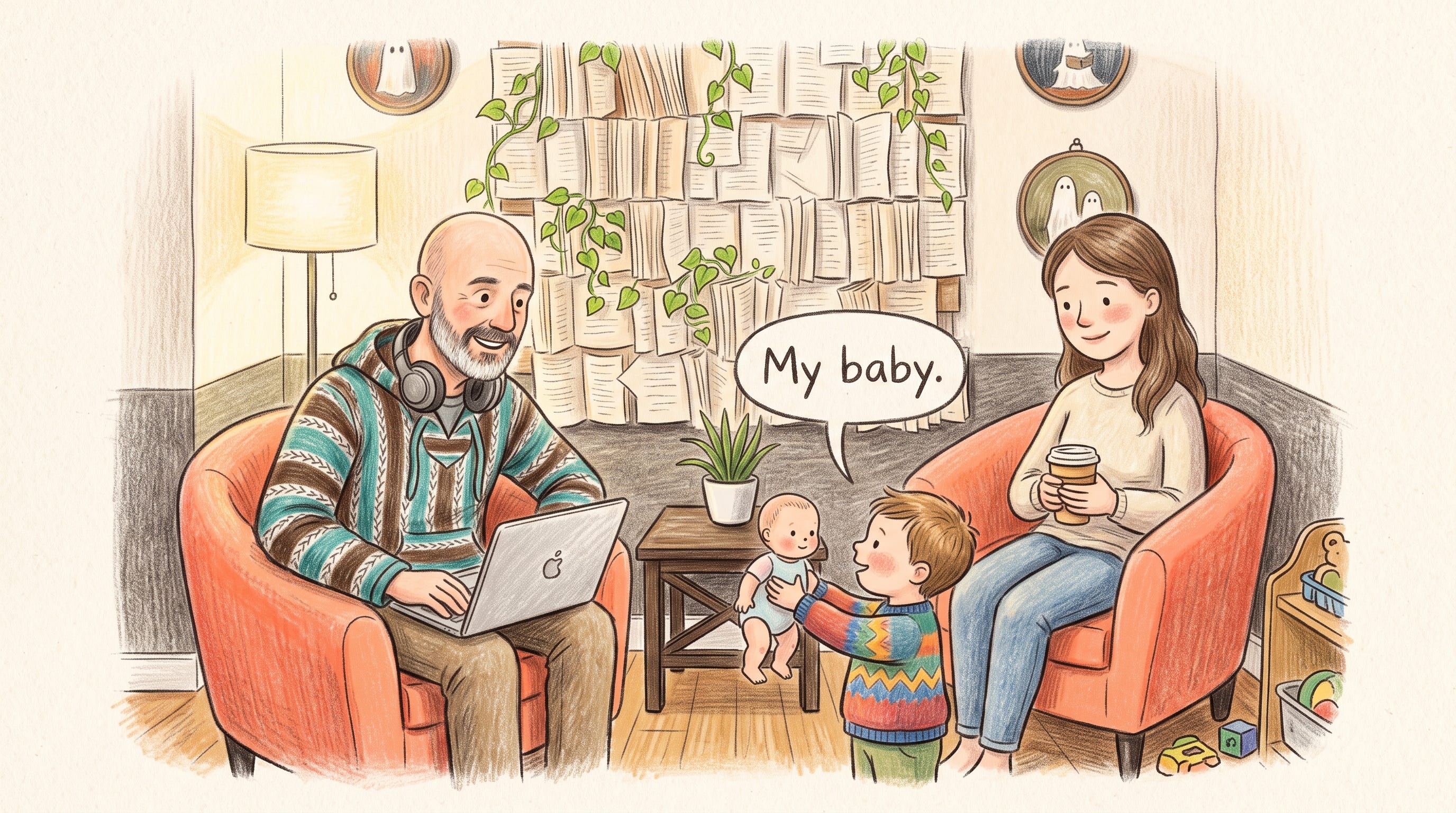
Here’s the part I love. He didn’t show his mom. She was two feet away. He wanted to show the man he had never met, and he showed it to me with pride.
Nobody had told him yet that a man might be the person you hide it from. There was no shame in him showing me the doll.
I’ve had mornings with random encounters and connections. This didn’t seem to be one of them.
I turned to his mom and told her what I was sitting there working on in that moment. A children’s book about the messages we send kids that quietly tell them to put parts of themselves away. How somewhere along the line boys learn that boys don’t play with dolls. Girls learn not to get dirty. None of it is natural, but it sticks with us.
She said she tries to encourage him to do whatever he wants. He loves to color. He loves stuffed animals. He loves dolls. It’s just what comes natural to him.
Then she told me he’s two and a half, and he has eight younger cousins. He’s the nurturer of the group.
That’s her word. Nurturer. At two and a half.
I couldn’t stop thinking about the Scene on Radio season on Men. In episode 10, psychologist and therapist Terry Real describes what he calls the halving.1
“You take a whole human being, you put a line down the center, you say all the qualities to the right of this line, we’re going to call masculine, and all the qualities to the left of this line, we’re going to call feminine. And we all know what goes on which side.”
Then he says what goes where. Strength, competence and aggression on the masculine side. Dependency, expressiveness and nurture on the feminine side.
Nurture. The exact word his mom used, with pride, about her son. It’s on the other side of Terry Real’s line.
Real says that line comes down on boys as early as three.
“Before our children have entered kindergarten, they show demonstrable disinclination to be emotional. They’ll feel it, but they already know better than to express it on the playground. They’ve already learned the code. I say before our kids have learned to read, they have read the code of patriarchy.”
Before they can read books, they can read the man code.
Sit with that. When I do, it’s just plain heart-breaking.
So that boy might have 6-months. A couple of years if he’s lucky. Then he starts reading what it means to be a boy, and what a boy shouldn’t do or feel or love.
My fear for him isn’t about a doll. A doll is a doll. My fear is that a boy whose first instinct is to take care of things gets slowly steered away from that instinct. Not by anybody being cruel. By kids on a playground. By adults who think they’re helping. By what’s on a screen. By what nobody says out loud. They’re just handing down messages they’ve been reading.
But here’s what really hit me that morning at Reverie.
I was that boy. I was the boy who loved playing with dolls. The boy who loved and nurtured his pet rabbit, Cupcake. The boy who cried every time he heard “We Are the World.”
So where did he go?
I don’t necessarily have an answer. I know I put things away. I know I don’t remember agreeing to it. Nobody sat me down and explained the rules. It happened in pieces small enough that I never noticed any of them leaving.
The code that got me was a boy’s code. But there’s a code on the other side of that line too. Real says it lands on girls closer to eleven or twelve, and it teaches them what Carol Gilligan calls the tyranny of the nice and kind. Be agreeable. Be accommodating. Put the rest away.
Different code. Same cut.
We’re all meant to outgrow things, and plenty of what I left behind I have no interest in carrying now. Outgrowing something and hiding it are two different things though. One is growing up. The other is putting a piece of yourself away and calling it growing up.
That’s why Heart-Strong is building something called Project Little You.
It’s a collection of children’s books about the parts we learn to hide. The first one is mine. It’s called Little Jeremy’s Heart-Strong Adventure, it’s me at five years old. The second one is Becca’s, about the creativity and the joy she set down along the way. They’re written for kids who haven’t started editing themselves yet.
But every adult who has read a draft has told us the same thing. They saw it in themselves. That’s the whole idea. Reach kids before they start putting parts of themselves away. And invite adults to look back through the curious eyes of their younger self, at what they already set down. We believe that if we do both, we can give people the courage to live as their whole selves.
More to come on Project Little You. In the meantime, I’ll leave you with a question.
What part of the little you did you put away and want to let back in?
This Substack is a production of Heart-Strong, a nonprofit centered around a simple belief. The world works better, for everyone and everything in it, when more of us are pulled by love than controlled by fear. Learn more at www.heart-strong.org
MEN, episode 10, from the Scene on Radio podcast, hosted by John Biewen with Celeste Headlee. Terry Real is a psychologist, therapist and author. https://sceneonradio.org/men/
Thanks, Jeremy, I too see the things now about myself that I have never seen before. It has been because of people like you in WMRJ.